
When Does a Retaining Wall Need Building Consent in New Zealand?
Retaining walls can look simple, but the consent rules are more specific than many property owners expect. Height matters, but it is not the only consideration. Many people, including some builders and landscapers, will tell you anything under 1.5m does not require a building consent but that is not true. Some of the answer comes from Schedule 1 of the Building Act and MBIE guidance.
The main questions are:
- How much ground does the wall retain?
- Is the wall supporting any additional load or surcharge?
- Will groundwater or surface water accumulate behind it?
- Is it close to a legal boundary, neighbouring building, driveway or slope?
- Will the completed wall (exempt or not) comply with the Building Code and local planning rules?
A retaining wall below 1.5 metres is not automatically exempt from building consent. Some walls between 1.5 and 3 metres may qualify for a separate rural-zone exemption, but only where strict engineering and location requirements are met. Even where consent is not required, the wall must still be structurally sound, durable, properly drained and safe. Simple walls may be coordinated by an architect or landscape architect and constructed by an experienced builder or landscaper. However, professional engineering advice should be obtained where there is surcharge, difficult ground, groundwater, nearby buildings, boundary risks or wider slope-stability concerns.
The basic retaining-wall consent rule
In most situations, a retaining wall does not require building consent where it:
- retains no more than 1.5 metres depth of ground; and
- does not support any surcharge or other load in addition to the retained ground.
This exemption comes from Schedule 1 of the Building Act 2004. The important wording is depth of retained ground, which may not be the same as the visible height of the wall. A useful starting point is:
| Situation | Likely consent position |
| Up to 1.5 m retained depth, level ground above and no surcharge | May be exempt |
| Up to 1.5 m, but supporting a driveway, building or other load | Building consent generally required |
| More than 1.5 m in an urban or residential setting | Building consent generally required |
| Up to 3 m in a qualifying rural zone | May qualify for the rural exemption |
| Wall close to a boundary | May still be exempt, but loading, excavation, drainage and planning rules must be checked |
An exemption removes the need to obtain building consent. It does not remove the requirement to comply with the Building Code.
Why wall height is not the only test
Measuring only the exposed face of the wall can give the wrong answer.
The exemption is based on the vertical depth of ground being retained. On a stepped or sloping site, this depth may change along the wall.
MBIE gives an example of a wall ranging from 900 mm to 1.8 metres, where the portion exceeding 1.5 metres requires building consent. This type of mixed situation should be confirmed early with the designer and council. The other major issues are surcharge, groundwater, ground stability and the wall’s relationship to boundaries and neighbouring property.
What is surcharge?
Surcharge is an additional load affecting the retained ground and increasing the pressure acting on the wall. It does not need to sit directly on the wall. A nearby feature can still affect the soil behind it.
- driveways and vehicle areas;
- parking spaces;
- buildings and foundations;
- swimming pools;
- another retaining wall; and
- sloping ground above the wall.
A 1.2 metre wall below a driveway may therefore require consent, even though it is below the 1.5 metre limit.
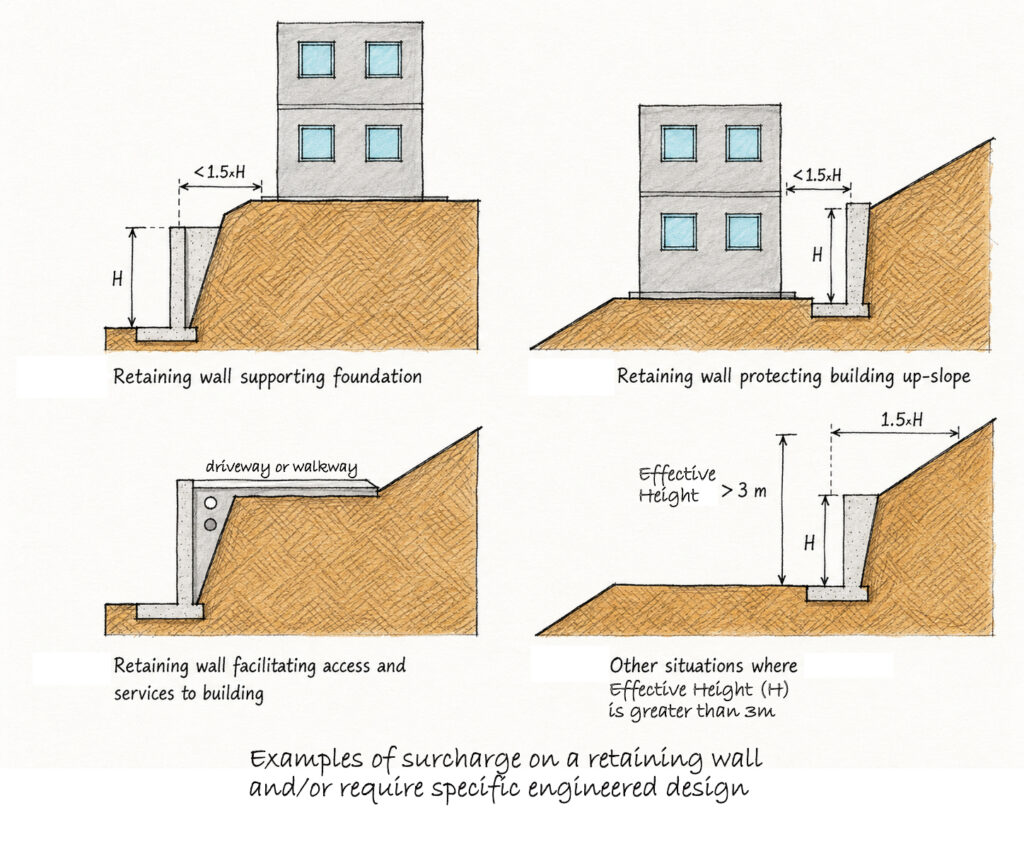
This is particularly important near boundaries. A neighbour’s driveway, building, parking area or sloping land may place surcharge on a wall located on your property. Gently sloping ground is not automatically a surcharge in every case. Professional advice may be needed to determine whether the slope creates a significant additional load.
Retaining walls on or near boundaries
There is no single national rule requiring every retaining wall to be a fixed distance from a boundary.
For the standard exemption covering walls up to 1.5 metres, Schedule 1 does not specify a minimum boundary setback. However, a wall near a boundary may require more careful assessment because it could:
- support neighbouring land, buildings or vehicles;
- undermine neighbouring ground during excavation;
- require footings, anchors, geogrid or drainage beyond the boundary;
- direct water onto neighbouring land; or
- be affected by local district-plan setback or earthworks rules.
The whole retaining system should generally remain within the property unless a formal legal arrangement permits otherwise. This includes the visible wall, footing, embedded posts, tie-backs, geogrid, crib-wall headers, drainage aggregate and construction excavation. BRANZ notes that the entire wall system and excavation need to fit within the legal boundary. Where a wall is close to a boundary, a survey may be needed to confirm the legal boundary before construction.
Consent and engineering design are separate questions
It is important to distinguish between:
- whether building consent is required; and
- how the wall must be designed.
A wall may require building consent but still be designed using a recognised prescriptive standard. A wall may also be consent-exempt but still require careful design to comply with the Building Code. Where a wall requires specific design, the appropriate professional may include a structural engineer, geotechnical engineer or both, depending on the wall and site conditions.
Drainage is essential
Water pressure behind a wall is an additional design load (not a surcharge). Drainage is therefore not optional simply because a wall is small or consent-exempt. Typical measures include:
- free-draining granular backfill;
- filter fabric;
- a perforated drain at the base of the wall;
- a suitable fall and lawful outlet; and
- surface-water management to prevent runoff entering behind the wall.
Drainage close to a boundary must not discharge onto neighbouring land or towards a neighbouring building. For seismic performance, well-compacted angular crushed aggregate is generally preferable to rounded river gravel, which can settle or move during earthquake shaking.
Ground conditions matter
Professional advice should be considered where the wall is:
- founded on soft clay, peat, uncontrolled fill or expansive soil;
- affected by a high water table;
- near steep ground falling away below the wall;
- in an area susceptible to liquefaction or slope instability.
Topsoil should be removed beneath wall foundations. BRANZ identifies very soft clay, peat, organic soils and unengineered fill as unsuitable for retaining walls even low walls.
Safety barriers
Where there is a fall of 1 metre or more from the top of a retaining wall, a barrier may be required under Building Code clause F4.
Whether a barrier is required depends on accessibility, surrounding use, the likelihood of children being present and whether the wall creates a sudden change of level associated with a building.
Barrier posts and foundations can also add load to the retaining wall and should be included in the design assessment. Where a retaining wall over 1 metre does not technically require a barrier, it may still be a good design decision to add a barrier or shrubs to prevent falls.
Building consent is not the only approval
A consent-exempt wall may still be affected by:
- district-plan height and setback rules;
- boundary and earthworks requirements;
- total volume of soil difference;
- resource consent conditions;
- easements;
- neighbouring-property obligations;
- services and utility infrastructure; and
- excavation safety requirements.
A neighbour’s agreement does not replace any required building consent, resource consent or engineering design. You can check with a duty planner at your local Council before starting a retaining wall design.
Common mistakes
Assuming every wall below 1.5 metres is exempt
The exemption applies only where there is no surcharge or additional load.
Measuring only the visible wall face
The relevant measurement is the depth of retained ground.
Ignoring a nearby boundary
The wall may support neighbouring land, require components outside the property or be affected by planning rules.
Ignoring sloping ground
A slope above may add load, while steep ground below may create a wider stability problem.
Treating rural walls as automatically exempt
The rural exemption requires the correct zoning, an design by an engineer and sufficient separation from boundaries and buildings.Overlooking drainage and Building Code compliance
Consent-exempt work must still be structurally adequate, durable, safe and properly drained.
Steps for Designing Retaining Walls
- Obtain reliable survey and level information.
- Confirm the legal boundary where the wall is close to it.
- Measure the maximum depth of retained ground.
- Identify driveways, buildings, pools, walls and slopes on both sides of the boundary.
- Check soil, groundwater and ground stability.
- Keep footings, reinforcement, drainage and excavation within the property.
- Select a standard, proprietary or specifically engineered design.
- Design the drainage and lawful outlet before construction.
- Check council planning and resource-consent requirements.
- Keep drawings, calculations and professional advice with the property records.
An Architect, or Landscape Architect or other lead designer can coordinate levels, access, planting, drainage, boundaries and the visual outcome. A Chartered Professional Engineer can assess structural and geotechnical matters where engineering design or review is required.

